Variations on the Implication
There are some simple ways we can change around an implication. Exactly how we make these changes affects how the new implication we form is related to our original starting implication. In this section, we look at three such variations — the converse, the inverse, and the contrapositive — and see how each one relates back to the implication we started with.
The Converse, Inverse, and Contrapositive
The first two modifications are relatively straightforward.
Consider the implication $p \to q$, which will act as our starting point. Here, $p$ and $q$ could be primitive or compound statements themselves.
The converse of $p \to q$ is the implication $q \to p$.
The inverse of $p \to q$ is the implication $\neg p \to \neg q$.
Basically, the converse is obtained by swapping the two statements on either side of the arrow $\to$. The inverse is obtained by negating both statements on either side of the arrow $\to$.
Of course, we can apply both transformations at the same time. There’s a special name for that transformation as well.
Consider the implication $p \to q$, where $p$ and $q$ could be primitive or compound statements themselves.
The contrapositive of $p \to q$ is the implication $\neg q \to \neg p$.
As always, an example in plain English will illuminate some key aspects of these kinds of propositions.
Consider the implication $t \to s$ where
\[ \begin{array}{rl} t\text{: } &\text{Taylor Swift releases a new album.} \\ s\text{: } &\text{The album will be successful.} \end{array} \]The converse could be translated as
$$\text{If an album is successful, then it was released by Taylor Swift.}$$The inverse can be translated as
$$\text{If Taylor Swift does not release an album, then that album will not be successful.}$$Finally, the contrapositive would basically read
$$\text{If an album is not successful, then it was not released by Taylor Swift.}$$Based on Taylor Swift’s past success, the implication $t \to s$ certainly seems like a reasonable statement that’s always true. However, notice that the converse doesn’t always appear to be true — plenty of successful albums have been released by artists other than Taylor Swift. AC/DC’s album Back in Black was a wildly successful album, and Michael Jackson’s Thriller is perhaps the best-selling album of all time.
The inverse doesn’t appear to be true all the time either (assuming $t \to s$ is always true, of course) — again, other artists release successful albums all the time.
The contrapositive is more interesting. Any non-successful album couldn’t have been released by Taylor Swift, because if it had been, then it would have been successful — Taylor Swift doesn’t make unsuccessful albums. So the contrapositive does seem to always be true. Furthermore, if we suppose $t \to s$ were false (unfathomable, but let’s imagine it for the sake of argument), then the contrapositive would also be false.
We have the following truth table relating an implication to its converse, inverse, and contrapositive.
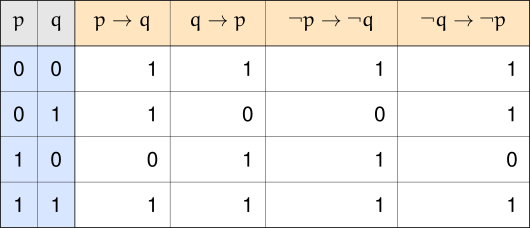
Notice that the values in the $p \to q$ column exactly match the values in the contrapositive column. This tells us that an implication is always logically equivalent to its contrapositive; in other words,
$$p \to q \Longleftrightarrow \neg q \to \neg p.$$Additionally, the values in the converse column exactly match those of the inverse column. This tells us that an implication’s converse is logically equivalent to its inverse, meaning
$$q \to p \Longleftrightarrow \neg p \to \neg q.$$Yet again, this is worth highlighting.
Since we’ve figured out that an implication is logically equivalent to its contrapositive, we could have deduced that the converse and inverse are logically equivalent just by noticing that the inverse is the contrapositive of the converse (and vice versa).