Arguments
The heart of mathematics is not mere computation, but the act of taking a combination of known facts and combining them in some way to arrive at new conclusions. Think back to when you learned the Pythagorean Theorem or the Quadratic Formula. It’s certainly true that these tools help you compute things — the hypotenuse of a right triangle, or the roots of a quadratic function — but that’s a computational activity.
Without the Pythagorean Theorem or the Quadratic Formula, how would we go about computing those quantities in the first place? There may be other methods available, but those two tools in particular are extremely helpful — and the reason they exist is that someone took what was already known about right triangles and quadratic expressions, and arrived at the now-famous results. The difference between doing mathematics and computing is a little like this: mathematics is knowing that for all right triangles, where the legs have lengths $a$ and $b$, and the hypotenuse has length $c$, we have
$$a^2 + b^2 = c^2;$$computation is figuring out that a right triangle with leg lengths $5$ and $12$ has a hypotenuse of length $13$ using the Pythagorean Theorem.
In order to know anything in mathematics, we start with what’s currently known, and extrapolate from that prior knowledge. We call this providing an argument, or a proof. In this section, we examine the basic structure of such an argument.
Premises and Conclusions
Let’s elaborate on the idea of using existing knowledge. We essentially take a collection of known facts together, and their combination provides some new fact:
\[ \begin{array}{ll} \text{IF} & \text{known fact \#1} \\ \text{AND} & \text{known fact \#2} \\ \text{AND} & \text{known fact \#3} \\ & \vdots \\ \text{AND} & \text{known fact \#}n \\ \text{THEN} & \text{new fact.} \end{array} \]Notice that we combine several facts using the word “and.” All the facts are supposed to come together in order to create the new fact — if any fact could be left out, then it wasn’t needed. This is the same situation we had with the conjunction $\land$: every proposition attached to a conjunction has to be true in order for the conjunction itself to be true.
Let’s rewrite the representation above using mathematical notation, where $p_1$ represents known fact #1 (a fact is just another term for a proposition), $p_2$ represents known fact #2, and so on through $p_n$ for known fact #$n$, with the letter $c$ denoting the new fact:
$$(p_1 \land p_2 \land p_3 \land \dots \land p_n) \to c.$$Consider a collection of $n+1$ propositions $p_1, p_2, p_3, \dots, p_n, c$. An implication of the form
$$(p_1 \land p_2 \land p_3 \land \dots \land p_n) \to c$$is called an argument. The propositions $p_1, p_2, p_3, \dots, p_n$ within the repeated conjunction are called the premises of the argument. The proposition $c$ is called the conclusion of the argument.
Notice that this definition doesn’t require the premises to be primitive propositions — each premise can be primitive, or it can be some long, complicated compound proposition. What matters is that we combine all of the premises into a conjunction.
Valid Arguments
Let $a$, $b$, $c$ represent the following propositions:
\[ \begin{array}{rl} a\text{: } &\text{The vault door is locked overnight.} \\ b\text{: } &\text{A thief breaks into the vault.} \\ c\text{: } &\text{The morning audit turns up clean.} \end{array} \]Now consider an argument with the following premises:
\[ \begin{array}{rl} p_1\text{: } &a \to c \\ p_2\text{: } &\neg b \to a \\ p_3\text{: } &\neg c \end{array} \]The argument we want to examine is $(p_1 \land p_2 \land p_3) \to b$.
We know that an implication is only false when the hypothesis is true and the conclusion is false. Working through a truth table for all three atomic propositions confirms that, in every row where $p_1 \land p_2 \land p_3$ is true, the conclusion $b$ is true as well — meaning the overall implication $(p_1 \land p_2 \land p_3) \to b$ has $1$s all the way down its column, and is a tautology.
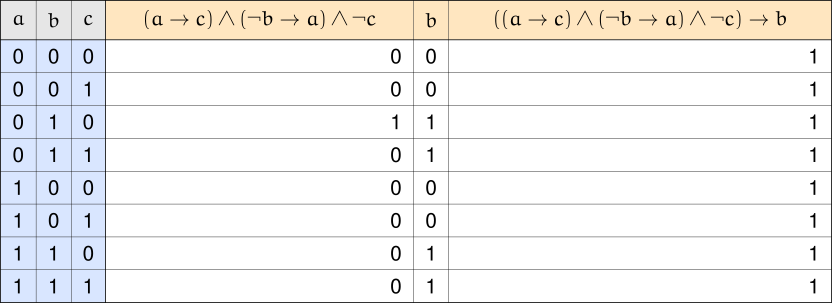
As such, we can write
$$(p_1 \land p_2 \land p_3) \Longrightarrow b.$$So, the argument is a logical implication. Therefore, if
\[ \begin{array}{l} \text{The vault door is locked overnight, then the morning audit turns} \\ \text{up clean;} \\[0.75em] \text{If no thief breaks into the vault, then the vault door is locked} \\ \text{overnight; and} \\[0.75em] \text{The morning audit does not turn up clean} \end{array} \]are all true propositions, then a thief likely broke into the vault somehow.
The previous example demonstrates something important about arguments: an argument asserts that, when all premises are true, the conclusion is also true. If there’s a scenario where all premises are true but the conclusion isn’t, then that argument doesn’t accurately reflect when the conclusion is true.
In order for an argument to accurately reflect when its conclusion is true, the conclusion must be true whenever the premises are true — otherwise, the argument is simply wrong.
On the other hand, we don’t care what happens when any of the premises are false. An argument only tells us that if all premises are true, then so is the conclusion — it’s irrelevant when any premise is false.
Consider an argument of the form $(p_1 \land p_2 \land p_3 \land \dots \land p_n) \to c$. If the implication is a tautology — that is, if it’s a logical implication with
$$(p_1 \land p_2 \land p_3 \land \dots \land p_n) \Longrightarrow c,$$then we call the argument a valid argument.
Mathematics is all about developing valid arguments, because these arguments form the base of the knowledge we have. Arguments give us a way to come up with new and efficient ways to perform computations, make classifications, or establish any other kind of equivalency.
Consider three propositions $x$, $y$, $z$ — none of which have to be primitive, they just each denote some proposition, whether simple, complex, or anywhere in between.
Now consider the following argument:
$$(p_1 \land p_2) \to c$$where
\[ \begin{array}{rl} p_1\text{: } &x \to y \\ p_2\text{: } &y \to z \\ c\text{: } &x \to z \end{array} \]Filling out a truth table for $x$, $y$, $z$ and each of these propositions in turn confirms that the column for $[(x \to y) \land (y \to z)] \to (x \to z)$ is entirely $1$s.
![The truth table for $x \\to y$, $y \\to z$, $(x \\to y) \\land (y \\to z)$, $x \\to z$, and $[(x \\to y) \\land (y \\to z)] \\to (x \\to z)$.](/books/foundational-mathematics/proof/arguments/02.svg)
As such, the argument
$$[(x \to y) \land (y \to z)] \to (x \to z)$$is valid. Therefore, if we ever run into a situation where we know that $x \to y$ and that $y \to z$, then we know that $x \to z$ as well, where $x$, $y$, and $z$ represent arbitrary propositions.