Simplifying Logical Expressions
In the previous section we saw an example where we used tautologically true biconditionals to “simplify” complicated propositional expressions into simpler propositional expressions. Whatever we could say about the simpler expressions could also be said about their more complicated, logically equivalent counterparts (except perhaps our preference for working with the simpler expressions, of course).
In this section we do more work with logical equivalencies, similar to what we saw in the examples seen previously. Our work here will bear a striking resemblance to our experience in dealing with the arithmetic and algebra of real numbers. In fact, the upcoming work we are about to engage with has been dubbed the “algebra of propositions.”
Revisiting a Previous Example
In the previous example, we saw how to take a complicated proposition and produce a simpler proposition that always had the same truth value.
Now that we have a big list of logical equivalencies under our belt, we can see how to use those equivalencies to more quickly find equivalent propositions, rather than trudge through truth tables all the time.
Previously, we made guesses about how the following propositions were related to each other:
\[ \begin{align*} & \neg \neg p \text{ compared to } p \\ & p \lor q \text{ compared to } q \lor p \\ & p \lor p \text{ compared to } p \end{align*} \]and used what we found to make a bunch of truth tables, which is reviewed below:
\[ \begin{align*} \neg \neg p &\Longleftrightarrow p \\ p \lor q &\Longleftrightarrow q \lor p \\ p \lor p &\Longleftrightarrow p \end{align*} \]Instead of using truth tables, let’s just use the laws of logic.
\[ \begin{array}{ll} (\neg \neg p \lor q) \lor p \Longleftrightarrow (p \lor q) \lor p & \text{by the Law of Double Negation} \\ (p \lor q) \lor p \Longleftrightarrow (q \lor p) \lor p & \text{by the Commutative Law of } \lor \\ (q \lor p) \lor p \Longleftrightarrow q \lor (p \lor p) & \text{by the Associative Law of } \lor \\ q \lor (p \lor p) \Longleftrightarrow q \lor p & \text{by the Idempotent Law of } \lor \\ q \lor p \Longleftrightarrow p \lor q & \text{by the Commutative Law of } \lor \end{array} \]We probably could have used fewer steps by more carefully applying the commutative and associative laws, but regardless, we arrived at the same proposition as we did in Example 1.5.4.
A New Example
Let’s turn our sights to a new example we haven’t seen before, and compare using truth tables to using logical equivalencies.
We’re interested in seeing if there’s a simpler, equivalent way of writing an expression like $\neg (p \to q)$ — one that doesn’t use the implication, but is instead just a combination of conjunctions, disjunctions, and negations. First, let’s construct a truth table for $\lnot (p \rightarrow q)$:
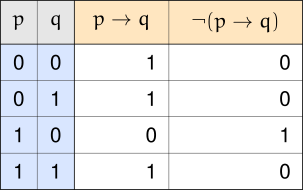
Suppose we didn’t know about the Laws of Logic. How can we proceed? We notice that there is only one $1$ in the column for $\neg (p \to q)$. We may remember that the conjunction of $p$ and $q$ also only has one $1$ as well.
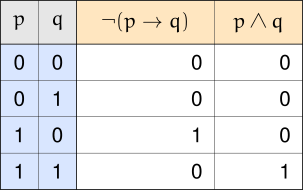
However, the $1$s aren’t in the same row. Notice that if we swap the $1$s and $0$s in the $q$ column, we can get the $1$s to line up with those for $p$. But how do we swap $1$s and $0$s of a proposition?
We negate it! Let’s add $\neg q$ to the table.
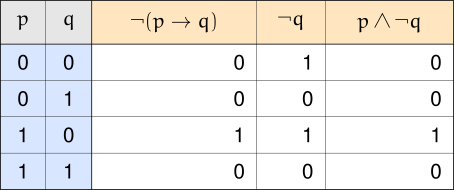
Now we see that $\neg (p \to q)$ and $p \land \neg q$ have the same truth values for all combinations of truth values, meaning
$$[\neg (p \to q)] \leftrightarrow [p \land \neg q]$$is a tautology.
Thus, we see that
$$[\neg (p \to q)] \Longleftrightarrow [p \land \neg q]$$Using the truth table method required us to make keen observations on how to work, manipulate, and coax truth values into the proper rows so they line up.
What if we don’t see a way to make values line up? Fortunately, there is a way we can avoid relying on our ability to make clever observations: we use the Laws of Logic!
Let’s use the Laws of Logic we have seen to try and come up with a logically equivalent proposition:
\[ \begin{array}{lll} & \boldsymbol{\neg (p \to q)} & \textbf{Reason} \\ \Longleftrightarrow & \neg (\neg p \lor q) & \text{Law of Material Implication} \\ \Longleftrightarrow & \neg \neg p \land \neg q & \text{DeMorgan's Law} \\ \Longleftrightarrow & p \land \neg q & \text{Law of Double Negation} \end{array} \]This is the same proposition we got by using truth tables! We just used logical equivalencies we were familiar with, instead of a keen eye (which may have blind spots). There was also a lot less work involved too!
A Note on Organizing Logical Equivalencies
In the previous example, we listed the logical equivalencies on separate lines, citing the logical law being appealed to. This is certainly a fine way to organize one’s work, and has its advantages.
In this book, we opt to use a tabular format to organize our work, unless the occasion calls for some other format. We adopt a three-column format:
\[ \begin{array}{lll} \Longleftrightarrow & \text{Propositional Expression} & \text{Reason} \end{array} \]We can demonstrate this format using the same proposition from the previous example.
Notice that we skip the first row in the left column. We also use bold font for the first row.
One Big Example
We’ve seen a couple of examples where we use a couple of logical laws. Some examples require more laws to simplify.
One thing to notice is that initially, we had four atomic propositions: $p$, $q$, $r$, and $s$. After all of our work above, we ended up with only two: $p$ and $r$. This means that the large, complicated compound proposition’s truth value actually is unaffected by $q$ or $s$. The truth value is driven, or affected, only by $p$ and $r$.