Satisfiability
We’ve seen plenty of primitive propositions whose truth values are fixed:
\[ \begin{array}{ll} \text{Calvin Coolidge was the 30th President of the United States of America.} & \text{(true)} \\ \\ \text{Mitochondria convert ADP into ATP via cellular respiration.} & \text{(true)} \\ \\ \text{Leonardo da Vinci painted the famous ceiling fresco in the Sistine Chapel.} & \text{(false)} \end{array} \]We’ve also seen compound propositions whose truth values depend on the truth values of its atomic propositions.
\[ \begin{array}{ll} 2+2=5 \text{ and } 2+3=6. & \text{(false)} \\ \\ \text{Parallelograms with four equal sides and four equal angles are squares.} & \text{(true)} \\ \\ \text{If an integer is prime and even, then that integer is two.} & \text{(true)} \\ \\ \text{If } x=2 \text{ or } x=3 \text{, then } x^2-5x+6=0. & \text{(true)} \end{array} \]Typically, the compound propositions we work with are made up of generic propositions that could be true, or could be false. This means we need to examine all combinations of truth values for the atomic propositions to determine the overall truth value of the compound proposition.
Of course, we usually will only be interested in compound propositions that are true. This is how we frame the upcoming discussion: when are compound propositions true?
Propositions that are Sometimes True
We’ve seen some examples of compound propositions that — for some combinations of truth values — are true.
We construct a truth table. We’ll highlight the column we are interested in examining.
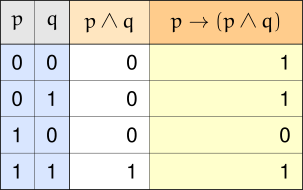
Only some of the combinations of truth values for $p$ and $q$ yield a truth value of $1$ when combined in the desired compound proposition. Those combinations are as follows: $p=0,q=0$; $p=0,q=1$; and $p=1,q=1$.
Only one combination yields a false truth value ($0$) when combined: $p=1,q=0$.
Let’s dispense with the suspense; we already know what word we’ll use to describe compound propositions that can be true.
A compound proposition is called satisfiable if there exists some combination of truth values for its atomic propositions that yield a truth value of $1$.
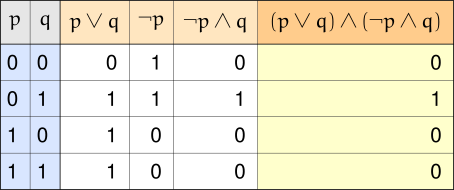
Here, we see that there is only one combination of truth values for $p$ and $q$ for where $(p \lor q) \land (\neg p \land q)$ is true, namely $p=0,q=1$.
Hence, $(p \lor q) \land (\neg p \land q)$ is satisfiable, even if just barely.
Propositions that are Always True
We have yet to see a proposition that is always true, no matter what combination of truth values are assigned to its atomic propositions.
We’ve seen $p \to (p \land q)$ above, but changing to the disjunction yields interesting changes.
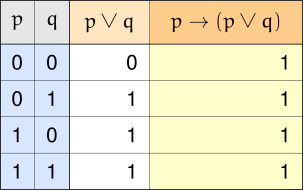
Notice that every row in the final column contains $1$.
A compound proposition is called a tautology when it is always true, no matter what truth values are taken by its atomic propositions.
Sometimes when we come across a tautology in an expression, we can replace it with the symbol $\top$ (sometimes also written $T_0$), but since the truth value is always $1$, we can always replace the expression with its truth value $1$.
It should be noted that it may preferable to either use $\top$ or $T_0$ when working with propositions, because those symbols have additional context to them than the literal value $1$. Those symbols signify that we are working with a proposition always happens to be true.
Propositions that are Never True
We’ve seen a proposition that is always true, but are there propositions that are never true?
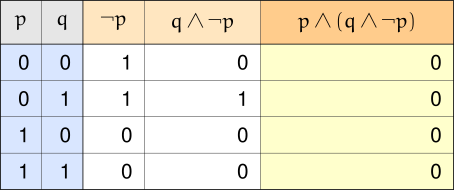
Of course, we should probably expect this proposition to always be false, because it is asserting both $p$ and $\neg p$.
You can’t assert both $p$ and $\neg p$, because they contradict each other — which leads us to our next definition.
A compound proposition is a contradiction when it is always false, no matter what truth values are assumed by its atomic propositions.
Just like with tautologies, we sometimes use the symbol $\bot$ (sometimes also written $F_0$) to represent a contradiction. But since a contradiction is always false, we can also just use $0$ — though we may prefer $\bot$ or $F_0$ if we wish to convey that we’re talking about a proposition, rather than a literal value.