Open Propositions
All of the propositions we’ve dealt with so far have had definite truth values. For example,
$$\text{Thomas Jefferson was the second president of the United States.}$$is a proposition that is known to be false. A statement such as
$$\text{2 + 2 = 4, or 2 + 2 = 5.}$$is a compound proposition that is true.
However, a statement such as
$$\text{$n$ is 1 more than a multiple of 3.}$$is not a proposition, because we don’t know whether it’s true or false. We would need to know the value of $n$ in order to reach such a conclusion. For example, the statement is false when $n = 5$, but true when $n = 16$. Here, we’ll deal with sentences involving variables like this one.
Open Statements
Consider the statement
$$x + 3 = 8.$$Here, we aren’t asking what value of $x$ solves the equation (we could, but that isn’t our focus). Instead, we’re asking whether, given a specific value of $x$, the statement is a true proposition or a false proposition.
We start by modeling the statement using a letter, like we’ve done up to this point, but we also use parentheses to denote the variable $x$:
\[ \begin{array}{rl} p(x)\text{: } &x + 3 = 8. \end{array} \]We can substitute values in for $x$ to get different propositions:
\[ \begin{array}{rl} p(5)\text{: } &5 + 3 = 8 \\ p(3)\text{: } &3 + 3 = 8 \\ p(-4.73)\text{: } &-4.73 + 3 = 8 \end{array} \]We can evaluate some of these propositions:
\[ \begin{array}{ll} p(5) &= 1 \\ p(3) &= 0 \\ p(-4.73) &= 0 \end{array} \]Consider the statement
\[ \begin{array}{rl} p(x)\text{: } &x \text{ was the 30th president of the United States.} \end{array} \]We can evaluate this statement with many values substituted in for $x$:
\[ \begin{array}{ll} p(\text{James K. Polk}) &= 0 \\ p(\text{Cecil Rhodes}) &= 0 \\ p(\text{Grover Cleveland}) &= 0 \\ p(\text{Calvin Coolidge}) &= 1 \\ p(\text{Bill Clinton}) &= 0 \end{array} \]Both of these examples are open statements — sentences with variables whose truth value can’t be pinned down until we substitute something in for those variables.
An open statement is any declarative sentence that has one or more variables, and thus is not a proposition, but becomes a proposition after values are substituted for all of its variables.
Just like with ordinary propositions, we write $p(x) = 0$ if the value of $x$ makes $p(x)$ a false proposition, and $p(x) = 1$ if the value of $x$ makes $p(x)$ a true proposition.
A statement $p(x)$ that represents an open statement with variable $x$ is often called a propositional function.
A propositional function can depend on more than one variable, as the next example demonstrates.
The U.S. Postal Service will only ship a package in a box that meets certain requirements: the sum of the box’s length and girth must not exceed 108 inches, where the girth is the perimeter of the box’s rectangular cross section.
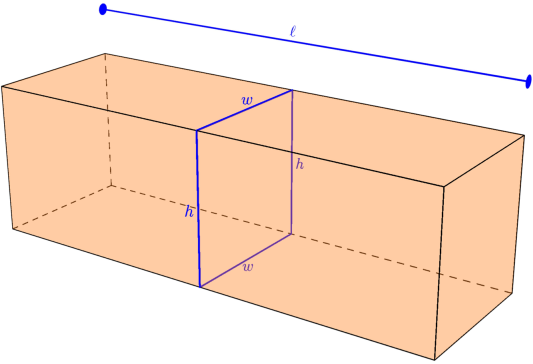
Letting $\ell$, $w$, and $h$ represent a box’s length, width, and height respectively, the perimeter of that cross section is $2w + 2h$. So, to comply with USPS shipping requirements, we need
$$\ell + 2w + 2h \leq 108 \text{ inches.}$$We can model this situation using a propositional function with three variables:
\[ \begin{array}{rl} s(\ell, w, h)\text{: } &\ell + 2w + 2h \leq 108 \text{ inches.} \end{array} \]Can we ship a box with dimensions $\ell = 32$ inches, $w = 16$ inches, and $h = 18$ inches?
\[ \begin{array}{lll} \boldsymbol{s(32, 16, 18)} & = & (32) + 2(16) + 2(18) \leq 108 \\ & = & 32 + 32 + 36 \leq 108 \\ & = & 100 \leq 108 \\ & = & 1 \end{array} \]Because $100 \leq 108$, we have $s(32, 16, 18) = 1$, so we can ship a box with these dimensions.
What about a box with dimensions $\ell = 20$ inches, $w = 18$ inches, and $h = 30$ inches?
\[ \begin{array}{lll} \boldsymbol{s(20, 18, 30)} & = & (20) + 2(18) + 2(30) \leq 108 \\ & = & 20 + 36 + 60 \leq 108 \\ & = & 116 \leq 108 \\ & = & 0 \end{array} \]Since $116 \not\leq 108$, we can’t ship a box with length $20$ inches, width $18$ inches, and height $30$ inches with USPS.
Constraining Inputs
Let’s reconsider the president example.
For the propositional function
\[ \begin{array}{rl} p(x)\text{: } &x \text{ was the 30th president of the United States,} \end{array} \]we could argue $p(3)$ is either false or undefined. We can eliminate this ambiguity by specifying what kinds of values we’re allowed to substitute into $p(x)$. If a value $a$ is allowed as an input, then $p(a)$ is either true or false. If a value $b$ is not allowed, then $p(b)$ is undefined.
Let’s restrict the values allowed as inputs to $p(x)$ to proper names. This means values like “James K. Polk,” “Cecil Rhodes,” “Grover Cleveland,” “Calvin Coolidge,” and “Bill Clinton” can be substituted for $x$ and will yield true or false.
However, when substituting a value for $x$ that isn’t a proper name, we’ll say $p(x)$ is undefined. Since $3$ isn’t a proper name, $p(3)$ is undefined.
We could further restrict the inputs to be names of U.S. presidents only, rather than just any proper name. In that case, $p(\text{Cecil Rhodes})$ would be undefined, since “Cecil Rhodes” isn’t the name of any U.S. president.
Reconsider the propositional function
\[ \begin{array}{rl} p(x)\text{: } &x \text{ was the 30th president of the United States.} \end{array} \]Suppose we restrict the allowable values to names of U.S. presidents, except “Calvin Coolidge.” Then $p(\text{Calvin Coolidge})$ would be undefined. Substituting any other U.S. president’s name yields $0$, since only Calvin Coolidge was the 30th U.S. president. Under this restriction, $p(x)$ never yields $1$ — only $0$, or undefined.
Restricting the allowable names to Spanish monarchs would also only ever yield $0$ or undefined, since no Spanish monarch was ever the 30th president of the United States. We could similarly restrict the allowable values to even integers — again, $p(x)$ would always be either false, or undefined.
Reconsider the propositional function
\[ \begin{array}{rl} p(x)\text{: } &x + 3 = 8. \end{array} \]If we restrict our inputs to integers only, we can make $p(x)$ true by substituting $5$ in for $x$. Any other integer yields $0$. Non-integers yield undefined values, since they aren’t allowed as inputs — so $p(3.14159265)$ is undefined.
However, if we restrict allowed inputs to any real number, $p(3.14159265)$ is no longer undefined — it’s equal to $0$.
The previous examples show that restricting the allowable inputs of a propositional function can greatly affect the truth values it yields. This collection of allowable values has a special name, and knowing what it consists of is vitally important.
For a given propositional function $p(x)$, the collection of values allowed to be substituted in for $x$ is called the universe of discourse, or just universe for short.
The universe is typically denoted $\mathcal{U}$, though other symbols may be used.
Consider the propositional function
\[ \begin{array}{rl} r(x)\text{: } &x \text{ has a right angle,} \end{array} \]with universe of discourse $\mathcal{U}$ the collection of all planar polygons.
Since the number $2$ isn’t a planar polygon, $r(2)$ is undefined.
Suppose $s_1$ represents a square with side length $1$. $s_1$ is a planar polygon, meaning $r(s_1)$ is either $0$ or $1$. Since every square has a right angle, $r(s_1) = 1$.
Suppose $s_2$ represents an equilateral triangle with side length $1$. $s_2$ is also a planar polygon. Since no equilateral triangle has a right angle, $r(s_2) = 0$.
As demonstrated earlier, a propositional function can have many variables — we’d need to specify the universe of discourse that all of those variables have to adhere to.
Consider the propositional function
\[ \begin{array}{rl} e(x, y)\text{: } &x + y \text{ is an even integer,} \end{array} \]with universe of discourse $\mathcal{U}$ for both $x$ and $y$ the integers. This means both $x$ and $y$ must be integers.
We’d have $e(2, 4) = 1$, $e(3, 7) = 1$, $e(1, 2) = 0$, and $e(4, 13) = 0$.
$e(2, 2.3)$, $e(2.18, 3.14)$, and $e(4.411, 10)$ would all be undefined, since $2.3$, $2.18$, $3.14$, and $4.411$ aren’t integers.
$e(2, \text{Monday})$ would also be undefined, since “Monday” isn’t an integer. Similarly, $e(\text{Red}, \text{Cactus})$ would also be undefined.
For $e(x, y)$ to yield $0$ or $1$, both $x$ and $y$ need to be integers.
It’s also possible to specify a separate universe for every variable in a propositional function.
Consider the propositional function
\[ \begin{array}{rl} q(x, y)\text{: } &x \div y \text{ is larger than 5.2,} \end{array} \]with universe for $x$, denoted $\mathcal{U}_x$, all real numbers, and universe for $y$, denoted $\mathcal{U}_y$, all real numbers except $0$.
Here, $q(2.2, 0.0001) = 1$, $q(10, 2) = 0$, $q(0.52, 0.01) = 1$, and $q(0.52, 0.1) = 0$.
$q(1, 0)$ would be undefined, since $0 \notin \mathcal{U}_y$.
$q(\text{Monday}, 1)$ would be undefined, since $\text{Monday}$ is not a real number.
$q(\text{Friday}, 0)$ would be undefined, since $\text{Friday}$ is not a real number, and $0$ is not a non-zero real number.
Of course, it’s also possible for some of a propositional function’s variables to share a universe of discourse, while others have some other universe.
Consider the propositional function
\[ \begin{array}{rl} q(x, y, z)\text{: } &(x + y) \div z = 1, \end{array} \]with universe for $x$ and $y$, denoted $M$, all integers, and universe for $z$, denoted $N$, all real numbers except $0$.
We have $q(1, 0, 1) = 1$, $q(-2, 7, 5) = 1$, $q(-1, 1, 1) = 0$, and $q(10, -23, 2) = 0$.
$q(0.1, 1, 1)$ is undefined, since the supplied value for $x$ ($0.1$) isn’t in $M$.
Similarly, $q(23, -3.14, 10)$ is undefined, since the supplied value for $y$ ($-3.14$) isn’t in $y$’s universe, $M$.
Finally, $q(20, -10, 0)$ is undefined, since the supplied value for $z$ ($0$) isn’t in $z$’s universe, $N$.