Modeling Logic with Truth Tables
We are often working with three or more propositions at a time, usually combined into large numbers of expressions made using the logical connectives discussed previously.
It can be cumbersome to work with them individually. Here, we will learn a technique for handling multiple expressions efficiently.
A Convenient Shorthand
To make our upcoming work easier, we adopt a common shorthand for truth values:
\[ \begin{align*} \text{False / false: } 0 \\ \text{True / true: } 1 \end{align*} \]Using numbers will make the following concept a bit more space efficient, and give a more mathematical flavor going forward.
Atomic Propositions: Building Blocks of Truth Tables
A truth table is simply a table organizing multiple logical expressions based on the truth values of their constituent, or atomic propositions.
By atomic, we mean propositions used to construct compound propositions by combining them with logical connectives.
In the expressions
\[ \begin{align*} & \neg p \\ & p \land q \\ & p \lor q \\ & p \veebar q \\ & p \to q \\ & p \leftrightarrow q \end{align*} \]$p$ and $q$ are considered atomic.
Note that atomic propositions themselves do not need to be primitive.
Let $p$ and $q$ be compound propositions defined as follows:
\[ \begin{array}{rl} p\text{: } &a \land b \\ q\text{: } &a \lor b \end{array} \]In the context above, $a$ and $b$ are the atomic propositions.
Now reconsider the six expressions from earlier:
- $\neg p$
- $p \land q$
- $p \lor q$
- $p \veebar q$
- $p \to q$
- $p \leftrightarrow q$
Here in these expressions, $p$ and $q$ are also considered atomic, since they are named propositions being connected together to form compound propositions. We could go a step further and substitute in the definitions of $p$ and $q$ given above, in terms of the propositions $a$ and $b$:
- $\neg (a \land b)$
- $(a \land b) \land (a \lor b)$
- $(a \land b) \lor (a \lor b)$
- $(a \land b) \veebar (a \lor b)$
- $(a \land b) \to (a \lor b)$
- $(a \land b) \leftrightarrow (a \lor b)$
In general, a proposition that is named or labeled (usually with a lowercase letter) is considered atomic because it can be used to build up other propositions when combined with other labeled propositions using the logical conenctives.
Constructing Truth Tables
As stated before, a truth table is simply a table showing the truth value of a logical expression based on the truth values of its atomic propositions.
Here is an overview:
- We start with the given expression, and identify all atomic propositions used to form it.
- We create a table with enough columns for all of the atomic propositions as well as the desired logical expression. We list all atomic propositions in the left-most columns, in alphabetical order. The last, right-most column is reserved for the desired proposition.
- Under the columns for the atomic propositions, we list all possible combinations of truth values between the atomic propositions. A good way to ensure that all combinations are listed is to follow a “rotary,” “dial,” or “odometer” method, where the right-most atomic proposition’s values change the most frequently between rows, and the first, left-most atomic proposition’s values cycle the least frequently between rows. Instead of dialing through digits 0 through 9 like an odometer, you flip back to 0 after reaching 1.
- For each row, evaluate the desired logical expression by substituting that row’s truth values in for its atomic propositions.
This yields a complete truth table for your desired expression. Let’s see an example where we fill out a truth table for the logical expression $p \land q$:
Step 1: Identify the atomic propositions
For $p \land q$, the atomic propositions are $p$ and $q$.
Step 2: Create an initial table that has enough columns to hold the atomic propositions and the desired proposition
There are two atomic propositions, along with the desired proposition, so our table needs three columns: $p$, $q$, and $p \land q$. We list the atomic propositions first, in alphabetical order, and then end with the desired proposition.
Step 3: List all possible combinations of truth values for the atomic propositions being used
Here is what the overall table’s structure will look like. In this book, we will use a blue color to color in all of the values for the atomic propositions, and an orange color for the desired expression’s column.
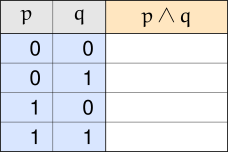
Examine the way the truth values for the atomic propositions have been laid out. As described earlier in the overview, we are listing each combination of truth values by essentially using a rotary or dial system. This ensures we list all possible combinations of truth values.
Step 4: Fill in all of the missing truth values under the desired proposition’s column
Let’s do this one row at a time. Let’s start with the first row, where $p = 0$ and $q = 0$, highlighted in this table:
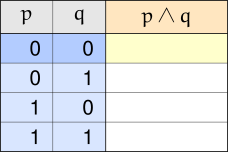
What value do we fill in to the highlighted, yellow cell? We need to refer back to the definition of conjunction: the conjunction of two propositions $p$ and $q$, denoted $p \land q$, is true only when both $p$ and $q$ are true. If either $p$ or $q$ is false, then the conjunction itself is false.
Remember that we use $0$ to represent a false truth value, and $1$ to represent a true one. In the row we’re examining, both $p$ and $q$ are false, since both are equal to $0$. Since not both $p$ and $q$ are true, $p \land q$ is false, so we write $0$ in the highlighted cell, as shown below:
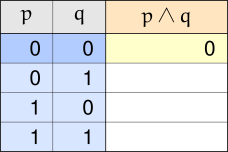
This leaves us with the following partially filled out table:
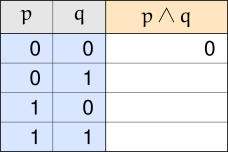
We continue on to the next row, where $p = 0$ and $q = 1$, highlighted below:
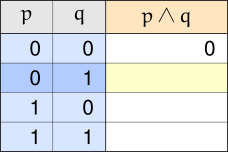
Appealing to the definition, since one of the atomic propositions is false — here, $p = 0$ — the conjunction $p \land q$ is also false. We place a $0$ in the highlighted cell, shown below:
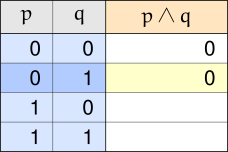
This leaves us with a slightly more filled out table, shown below:
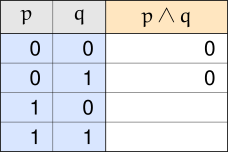
Let’s continue on and examine the third row, where $p = 1$ and $q = 0$. Here, since one of the atomic propositions is false, the conjunction $p \land q$ continues to be false, and we fill in a $0$ in the third blank cell, shown below:
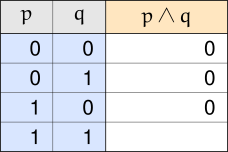
Now we are on the last row, where $p = 1$ and $q = 1$. Here, both atomic propositions are true. This means the conjunction $p \land q$ is, by definition, true. That means in this final blank cell we fill in a $1$, leaving us with the completed truth table for the conjunction $p \land q$:
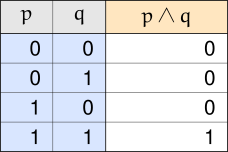
This example shows the basic procedure. From now on, we can just fill in the values as needed, without any need to repeat any of the exposition here.
Truth Tables for the Logical Connectives
We have seen how to construct a truth table from scratch. Now, it’s really just a matter of appealing to the definitions of the logical connectives in order to construct truth tables for them. Knowing the truth tables for the logical connectives is going to make working with even more complicated expressions much easier, since any complicated expression is essentially just a bunch of atomic propositions combined with the logical connectives described here.
Here, we are going to use $p$ and $q$ as the atomic propositions for the expressions.
Negation $\neg$
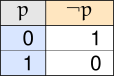
This is a really simple truth table, since negation can operate on one proposition at a time. Remember that the negation of a proposition has the opposite truth value of the proposition itself.
Conjunction $\land$
We already saw this in the example above, but we’ll show the table here for the sake of completeness.
Disjunction $\lor$
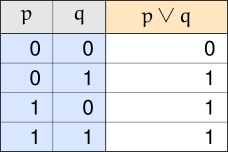
Based on the definition of disjunction, we know that if at least one of the atomic propositions is true, then the disjunction itself is also true.
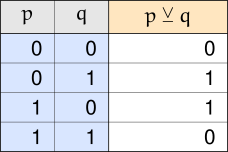
Exclusive-or $\veebar$
The definition essentially tells us that the exclusive-or of two atomic propositions is true whenever the atomic propositions have different truth values; or put another way, not equal to each other.
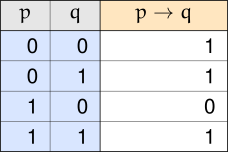
Implication $\to$
The definition of implication tells us that the only time an implication is false is if $p$ is true, and $q$ is false. Otherwise, the implication is true.
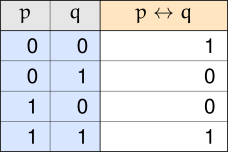
Biconditional $\leftrightarrow$
The definition for a biconditional essentially tells us that if the two atomic propositions have the same truth value, meaning they are equal to each other, then the biconditional itself is true. It is false otherwise. We can almost think of the biconditional as being the exact opposite of an exclusive-or between two propositions.
Combining All Logical Connectives Into One Table
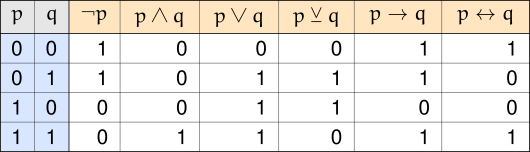
Something we can do is simply append the columns for each of the logical connectives into one big overall table. You have to be careful when doing this to make sure the rows line up with the appropriate rows for the atomic propositions. If the order of the atomic propositions differs, or if the numbering method used yields a different ordering for the combinations of truth values for the atomic propositions, the results may not be correct.
Here, we used the same ordering for the atomic propositions themselves, and the combinations of truth values for those atomic propositions. We will have to extend the negation table by an additional two rows, but again, we fill in any values needed by appealing to the definition of negation, and paying attention to the values of the atomic propositions in the row we are evaluating.
Intermediary Columns
Notice that we just produced a truth table that has more than one expression column, one expression column for each of the logical connectives we use to form compound propositions.
If we are trying to determine the truth value of a complicated expression, we can do the same thing. We can identify all of the parts of the more complicated expression, and gradually build up the truth value of the final, desired expression. Doing this helps us keep track of values, preventing us from having to work out complicated expressions all at once.
We use so-called intermediary columns to hold the parts of the complicated expression that are easy to calculate. Usually, we break a complicated expression up based on where the logical connectives are. Here is an example.
Consider the expression $\neg (p \land q)$. Working out its truth value directly, row by row, means checking $p$, checking $q$, combining them with conjunction, and then negating the result — three things to keep in your head at once for every row.
An intermediary column makes this easier. We start by building a table with an intermediary column for the simpler piece, $p \land q$ — a table we already know how to construct — alongside the column for the desired expression $\neg (p \land q)$ itself, still blank:
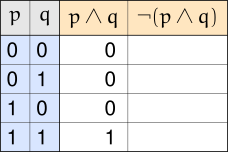
To fill in that blank column, we no longer need to think about $p$ and $q$ at all — we just take the negation of whatever is already in the $p \land q$ column, one row at a time:
\[ \begin{array}{l|l|l} p \land q & \neg (p \land q) & \text{Result} \\ \hline 0 & \neg (0) & 1 \\ 0 & \neg (0) & 1 \\ 0 & \neg (0) & 1 \\ 1 & \neg (1) & 0 \end{array} \]All we need to do now is copy the Result column from the above table into the truth table we are building.
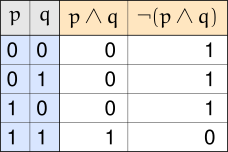
That’s the advantage of an intermediary column: instead of working out $p$, $q$, and the negation of their conjunction all at once, we break the work into two simple steps, each of which is just a single connective’s truth table.
Consider the expression $p \land (\neg q \lor \neg r)$. This one has three atomic propositions — $p$, $q$, and $r$ — so its full truth table needs eight rows, and this time we’ll use more than one intermediary column.
We start with intermediary columns for the two simplest pieces, $\neg q$ and $\neg r$:
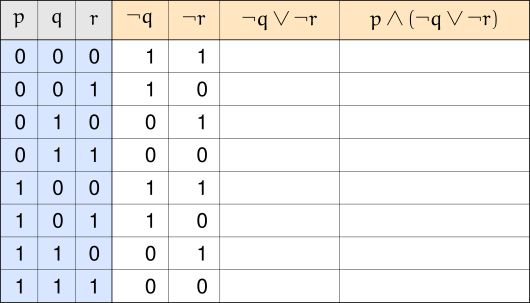
With those two columns in hand, we build a third intermediary column for $\neg q \lor \neg r$, taking the disjunction of the two columns we just built, row by row:
\[ \begin{array}{l|l|l|l} \neg q & \neg r & \neg q \lor \neg r & \text{Result} \\ \hline 1 & 1 & 1 \lor 1 & 1 \\ 1 & 0 & 1 \lor 0 & 1 \\ 0 & 1 & 0 \lor 1 & 1 \\ 0 & 0 & 0 \lor 0 & 0 \\ 1 & 1 & 1 \lor 1 & 1 \\ 1 & 0 & 1 \lor 0 & 1 \\ 0 & 1 & 0 \lor 1 & 1 \\ 0 & 0 & 0 \lor 0 & 0 \end{array} \]All we need to do now is copy the Result column from the above table into the truth table we are building.
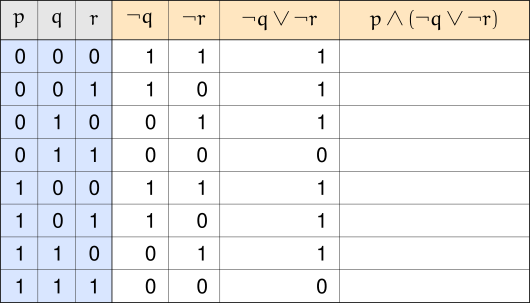
Finally, filling in $p \land (\neg q \lor \neg r)$ is just a matter of taking the conjunction of $p$ column with the $\neg q \lor \neg r$ column we just finished — no need to think about $q$ or $r$ individually at all:
\[ \begin{array}{l|l|l|l} p & \neg q \lor \neg r & p \land (\neg q \lor \neg r) & \text{Result} \\ \hline 0 & 1 & 0 \land 1 & 0 \\ 0 & 1 & 0 \land 1 & 0 \\ 0 & 1 & 0 \land 1 & 0 \\ 0 & 0 & 0 \land 0 & 0 \\ 1 & 1 & 1 \land 1 & 1 \\ 1 & 1 & 1 \land 1 & 1 \\ 1 & 1 & 1 \land 1 & 1 \\ 1 & 0 & 1 \land 0 & 0 \end{array} \]We then copy the Result column from the above table into the truth table we are building, same as usual.
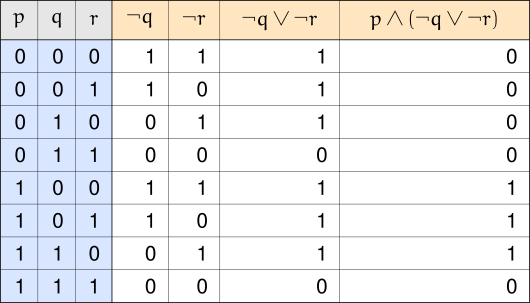
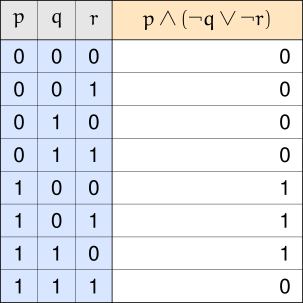
We could leave the table as it is, with a column for every intermediary piece we used along the way. Or, we could construct a condensed table that only shows the atomic propositions along with the desired expression.