Logical Order of Operations
Just like in the arithmetic of real numbers, there is an order we should follow when evaluating logical expressions.
For instance, in the arithmetic of real numbers, we abide by the following rules:
- Parentheses $()$
- Exponents
- Multiplication and division (left to right)
- Addition and subtraction (left to right)
Using this scheme for evaluating arithmetic expressions, we do the following:
\[ \begin{align*} 2 - 3^2 \cdot (4 + 6 \div 2) &= 2 - 3^2 \cdot (4 + 3) \\ &= 2 - 3^2 \cdot 7 \\ &= 2 - 9 \cdot 7 \\ &= 2 - 63 \\ &= -61 \end{align*} \]Here we introduce a scheme to help us determine which operations should be done in order to achieve the correct final result.
Why Order Matters
Consider the following example.
There are two ways to evaluate this expression.
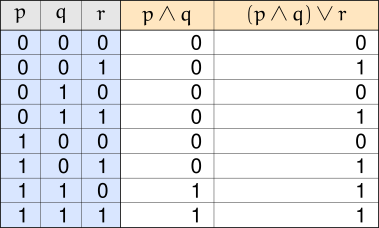
Method 1: $(p \land q) \lor r$
Method 2: $p \land (q \lor r)$
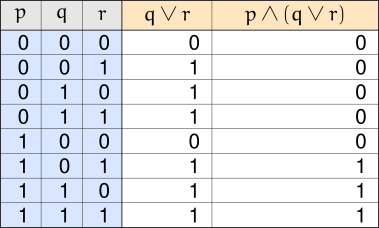
Note that from what we see,
$$(p \land q) \lor r \neq p \land (q \lor r)$$when $p = 0$, $q = 0$, $r = 1$, and when $p = 0$, $q = 1$, $r = 1$.
Based on this calculation, we see that the expression
$$p \land q \lor r$$is ambiguous — we don’t know how to evaluate it until parentheses are added, or until some order of operations is established.
Establishing an Order of Operations
The following is a commonly used scheme for an order of operations:
- Parentheses $()$
- Negation $\neg$
- Conjunction $\land$
- Disjunction $\lor$
- Exclusive-or $\veebar$
- Implication $\to$
- Biconditional $\leftrightarrow$
Using this order, we remove any ambiguity from logical expressions.
Using the previously established order of operations, we see that the expression
$$p \land q \lor r$$is equivalent to the expression
$$(p \land q) \lor r$$Suppose we had that $p = 1$, $q = 0$, $r = 1$. Then we’d have that
\[ \begin{align*} (p \land q) \lor r &= (1 \land 0) \lor 1 \\ &= 0 \lor 1 \\ &= 1 \end{align*} \]If we wanted to evaluate the disjunction first, we’d have to use parentheses, since
$$p \land (q \lor r)$$is not equivalent to the expression $p \land q \lor r$.
Using the Order of Operations
With the order of operations, we remove any ambiguity, and do not have to rely on parentheses unless we want to give precedence to operations lower in the order.
The final simplification reveals the final, overall truth value to be $0$.
A Note on Conventions
In this book, we adopt the above order of operations, but will only make shallow use of it. Basically, what this effectively means is that we will make very liberal use of parentheses, even when they aren’t strictly necessary.
While the relative order between $\neg$, $\land$, $\lor$, $\to$, and $\leftrightarrow$ is somewhat standardized (heavy emphasis on the word “somewhat”), it is hardly universal. This is especially true when $\veebar$ is thrown into the mix.
Many texts use $()$ liberally as well. In some ways, the order of operations presented here was entirely engineered to meet this book’s needs, and this order’s scope is only contained within this book.
This is why, going forward, we will hardly rely on this order of operations, and instead opt to use the standard trick of using $()$ to indicate which operations take precedence over others.
A Note on Organizing Arithmetic
A blank piece of paper allows one to express an idea anywhere on the page, in any arrangement. But following a chain of arithmetic is much easier when it’s laid out in a consistent, organized manner.
In this book, any arithmetic (based on real numbers, logic, or some other system) will generally be shown in a tabular format. There will be two benefits to this:
- Relatively easy to follow from one step to the next.
- Justification for each step can be explicitly shown.
Let’s see an example.
There is a slightly different format we’ll use for expressions that don’t already appear in a large, single block.